Archive | Media RSS feed for this section

The Good Feminist: Anarchic and slightly deranged

21 May

feminist


Helen Razer wrote this about feminism today.

In response, Clementine Ford wrote this about what Helen Razer wrote about feminism today.

Make of these differing view points what you will, that’s not my goal. What did catch my attention was Ford’s use of the words “anarchic and slightly deranged” to describe what she calls Razer’s “moments of incisive clarity” [on feminism today]

It seems Ford is using the term “anarchic” in a pejorative sense, which is interesting, as I’ve never thought of anarchic as a bad look for a woman, especially a feminist, to adopt.  It is a surely part of our job to do our best to transgress the hierarchical, patriarchal systems that repress and oppress us. Quite how one does that without a bit of anarchy, I don’t know.

“Deranged,” even slightly, is another kettle of fish. This is to do with insanity, psychosis, loss of contact with reality, a disturbed “normality.” It’s no different from calling a woman crazy, and we all know the power of that descriptor to hurt, intimidate, and silence when applied by the orthodoxy to the words of women it does not want to hear, or wishes to discredit.

Personally, I have no time for words such as “deranged” in a feminist vocabulary. They belong to the Law of the Father, as Cixous would have it. They are the consequence of a social process whose product is, among other things, concepts such as “sanity” and “madness.”  Part of our feminist task is, as Foucault would have it though he was not speaking specifically to feminism,  that we must disrupt discursive practices which establish meaning. Perhaps there is little more important than disrupting those established practices that create a narrative of derangement that has long been used to contain and oppress mouthy, disruptive, revolutionary women.

Has feminism now become so tamed that words such as “deranged” are required to invalidate commentary because its content may not be immediately accessible and its form extraordinary?  Strategies of excess can be used most effectively to challenge the binaries of patriarchal thought, but has feminism become so tamed it must now regard such strategies as “deranged?”

Women today would not have a fraction of the privileges we have were it not for radical, anarchic women who were frequently described as “crazy.” No successful political movement ever existed without radicals to initially break through the barriers.

There is practically no one influential in Western feminism today who can be described as radical. I wonder how much this is due to so many feminists becoming so much a part of the bourgeoisie with its safe, bourgeois values that radical voices are now inevitably named as “deranged,” and thus ridiculed, or silenced.

Naming is a political activity.  “…all expression is always indirectly political.” Cixous.

Dear Clementine Ford. How I feel when you talk about me.

15 May


us-them


The following are extracts from Clementine Ford‘s recent article “What Cleveland tells us about the cycle of abuse,” on the kidnapping and imprisonment of three women and a child in Cleveland, Ohio.

There’s no doubt that the facts of the case are horrific, both those known and those yet to be revealed to the authorities required to know them. (Despite our general fascination with salacious details, even those we find emotionally difficult to bear, this is not our story; the women involved are at last able to shield themselves from invasion, and that includes protecting themselves if they so choose from the world knowing to what depths the humiliation was that they suffered.)

What happened in Cleveland is horrifying, yes. It’s incomprehensible. To imagine the reality of those 10 years would cause too much distress, so we hover around its dark edges, not quite daring to look beyond the borders with anything other than quick glimpses in case our eyes lock on something we can’t unsee. But we should resist the temptation to consider it different somehow to the violence expressed on a daily basis in homes on similar suburban streets occupied by similarly “normal” people, domestic matters in which we imagine we have no obligation to get involved. 

What I am questioning in this piece is Ford’s use of the words “our” and “we.” For whom does she speak? Who is the “we” on behalf of whom, and to whom Ford enunciates? When Ford writes “our,” with what audience does she imagine she is engaging?

As a woman who survived childhood sexual and physical abuse on a scale that I still, and always will find “emotionally difficult” to bear, I do not feel included in Ford’s “we” and “ours.”

For example. I do not share our “general fascination with salacious details.”  Such details would plunge me into places I do not wish to go, because I have lived many of them. Having lived them, I am immediately framed as “not our,” and “not we” in Ford’s narrative, whose point of view, it seems to me, is entirely that of a “we” and “ours” who have not endured monstrous events.

There is, of course, nothing wrong with this perspective. Not everybody has to suffer torment. But there is something terribly wrong when it is presented as the perspective, excluding those of us who have a very different experience of life, while simultaneously  making us the centre of the discussion. This inevitably creates a binary of us and them. It positions women like me outside of the centre, as represented by mainstream writing and reporting.

Women such as myself are absent in this piece of writing that is also absolutely about us. Without us, this text would not exist, yet our voices are silenced by Ford’s appropriation of our lived experience , an appropriation in which there is no place for our presence. We can be talked about. We cannot speak.

We are made the object of Ford’s, and her readers’ gaze, no matter how sympathetic and empathic that gaze may be. We are positioned outside the social order, as represented by Ford’s use of “we” and “ours.” Women such as myself cannot possibly envisage ourselves as belonging in, and to this “we” and “ours.” It is against this “we” and “ours” that women such as myself must struggle to find a place for ourselves in a culture that through no fault of our own, casts us as outside its linguistic parameters of belonging.

There is a barrier between those who’ve known violence and those who haven’t. Because of this barrier, we are forever outsiders. Our secrets set us apart. Dark knowledge taints us. We’re sullied, dirtied, spoiled by our knowledge and we struggle to rid ourselves of this legacy. We are not the “we” and “ours” who fear seeing what we can’t unsee. We have seen the unseeable. We have lived the unlivable. We are the aporia, we are that which cannot be contained within the structures and logics of texts such as Ford’s. We are, by our experiences, made other, and we are further othered by hegemonic writings that exclude us, except as objects of the sympathetic gaze.

Feminist thinker  and writer Hélène Cixous suggests that we should not think of women such as myself as “victims,” but rather as “subjects of suffering.” …human beings, she continues, try to live through the worst sufferings. To make humanity of them. To distil them, to understand their lesson. We do this, those of us who can. Many of us can’t. Many of us die. Many of us live lives of unimaginable difficulty. Most of us never have a voice. We must put up with hearing about ourselves and our experiences from others, who shudder at the horror we’ve endured. This serves only to further marginalise us. This makes us spectacle.

What happened in Cleveland is not “incomprehensible” to me, as it is to the “we” Ford addresses. It is all too comprehensible.

Unlike the “we” Ford addresses, there is no temptation for me to consider what happened in Cleveland as “different” from what happened for years in my outwardly “normal” home on an ordinary street, except in some of the specifics.

The call for the “community” to take action to prevent such ruptures as the Cleveland events, or indeed my own sufferings, seems extraordinarily naive to me. How are we to depend on a “community” whose prominent feminist spokespeople see us as other, however empathetically, and exclude us from their discourse?

To imagine the reality of those 10 years would cause too much distress, so we hover around its dark edges, not quite daring to look beyond the borders with anything other than quick glimpses in case our eyes lock on something we can’t unsee.

These are the words of the privileged, who can choose to avoid the distress, who can hover, salaciously, around the dark edges, lacking the courage to cross the borders and walk with those of us who’ve had no choice in the matter, and who can never fully return from that dark country to the land of “we” and “ours.”

Those of us “subjects of suffering” who have survived enough to speak have much to offer, weighted with the authority given to us by our lived experience. We could tell you, for example, that there is a universe of difference between sexual harassment, and the violence we have endured. You may not care to hear that, but we can tell you that is so.

Given the horrific statistics for violence and sexual violence against women in this country, there must be many of our number among Ford’s readers. Yet writing such as this excludes us all. There must be many others who, like me, read this piece and think, I am not of this ‘we.” I am not of this “ours.”  This is not written for and to a woman with a life such as mine has been. It is written about women like me, but it is not written with me. It does not walk with me. It does not take my hand. It does not acknowledge me as an equal. It is writing that distances itself from me, and me from it.

If we are to intervene in the cycles of violence that bring abject horror to the lives of so many of us, we are first going to need a new discourse with which to do it. That discourse will  not create a barrier between those of us who have suffered and those of us who have not. There will be no excluding “we” and “ours.”  We do not need sympathy. We do not need to be isolated in our suffering. We need those who will walk beside us, equals in our shared humanity, no matter how varied our experiences.

If feminism cannot do this for women, it is a failed project.

This is how I feel when you talk about me.


Reist, Devine &sexually suggestive tweets.

12 May
Media eating itself

Media eating itself


There’s been something of a small online kerfuffle these last couple of days, with first Melinda Tankard Reist going public over a sexually suggestive tweet she received, and then Andrew Bolt publishing on his blog an impassioned defence of Miranda Devine, also the recipient of a sexually suggestive tweet from Mike Carlton, whom Bolt describes as a “boor.”

Bolt’s blog drew an online mea culpa from Catherine Lumby, who inadvertently retweeted Carlton’s comments before she realised they contained sexual suggestiveness.

Reist ‘s offensive tweet dates from the period when she initiated legal action against me, and Twitter took up my cause in a manner for which I will always be grateful. Reist claims in Chris Kenny’s piece in The Australian (linked above) that she has received appalling sexist and misogynist communications, including rape threats. This is the tweet she chose to take action against:

“So, has anyone found naked pictures of #mtr (Tankard Reist)? She is rootable in that religious feminist way.”

The author of the tweet, Darryl Adams, outed himself a couple of weeks later in the comments section of a Drum piece on the treatment Reist has received during her career as an anti- pornography campaigner. Adams used the persona “Fake Paul Keating” for his Twitter account. He is a public servant, and his tweeting had nothing to do with his working life.

Nevertheless, Reist did not approach Adams to complain that she was offended by his comments. She went straight to his employer, the Australian Tax Office.

Adams was duly spoken to. We do not know what form his punishment took, but his “Fake Paul Keating” account no longer exists. The ATO, for reasons known only to itself, failed to notify Reist that any action had been taken for several months.

This further enraged Reist, who felt the whole system had failed her as a victim of sexual harassment and intimidation. I encourage you to read the article in full.

Miranda Devine posted on Twitter that she was “embedded with NSW Police Public Order & Riot Squad,” with an accompanying photo. Mike Carlton then tweeted: 

“@mirandadevine is ‘embedded’ with the Police Riot Squad, as she puts it. What, all of them at once? Must be exhausting.”

Devine contacted him to request that he remove the tweet immediately. Carlton has since apologised and deleted the tweet.

Read the Bolt blog in full if you can bear it.

I’m not expressing any opinions on these situations. I’m leaving it to you. Please don’t make any sexually suggestive comments, and remember the Sheep rules, which you have so beautifully honoured recently. 🙂


If you see a child as “sexualised” there’s something wrong with your vision

4 Mar

On morals campaigner Melinda Tankard Reist’s website you’ll find this breakdown of a survey conducted by Girlfriend magazine on the sexual habits of their young readers. The magazine’s demographic is girls aged between twelve and seventeen.

The survey found that 75% of Girlfriend readers are not sexually active. The reasons given:

  • Waiting to be in love (56%)
  • Not wanting to have sex (37%)
  • Feeling too young (31%)
  • No particular reason (26%)
  • Waiting to be married (17%)
  • Waiting to be the legal age of consent (14%)
  • Waiting for their boyfriend/girlfriend to be ready (8%)
  • Not being interest in ever having sex (1%)

These reasons don’t appear to differ from reasons given by young women over the last few decades. It’s also possible, though unverifiable I imagine, that over the last few decades 25% of young women have engaged in some kind of sexual activity for a variety of reasons, just as they do today.

The Girlfriend survey appears to contest anecdotes such as those in the article “Stealing the innocence of children” published yesterday in the Fairfax Press. Using language such as onslaught, obsession, bombardment, and phrases such as “placing the child in a sexualised space,” “increasingly sexual and sexualised culture,” “hyenas circling” our young, and “people conditioned to see themselves as ‘product,'” the article paints an alarming picture of an apocalyptically sexualised society, controlled by a terrifyingly nebulous “them.”  The closest I can come to identifying “them” are as the manufacturers, producers, distributors  and marketers of a perceived “sexualised” and “pornified” popular culture.

They are further identified in the article as  “the seamier side of humanity” which has persuaded K-Mart, Target and other retailers to provide children’s clothing modelled on the imagined uniform of sex workers.

Children’s primary carers are obliged to buy  this inappropriate clothing and give it to kids to wear, causing them to look “hot” and “sexy.”

It takes a particular kind of perverted vision to see a child as “sexy” or “hot,” no matter what the child is wearing. I do not see children dressed in “sexy” clothing as “hot.”A child dressed like an adult looks to me like a child dressed like an adult. If the child is perceived as “sexualised” or “pornified” it must be the gaze of the adult viewer defining her as such, not the clothing and certainly not the child. It is impossible to “sexualise” and “pornify” a child by dressing her or him in any kind of clothing. Only a sexualising and pornifying gaze can impose that interpretation.

Further, I’d suggest that those currently most responsible for “sexualising” and “pornifying” children’s appearance are the very campaigners who complain most loudly about it. These people are demanding that we all adopt the pedophile gaze, and interpret a child’s appearance as “hot” and “sexy” rather than seeing it for what it is: children imitating adults. There is no innocence lost in the imitation. The innocence is destroyed by the adult’s sexualising gaze.

To others less inclined to make moral judgements based on bits of cloth, children are neither sexualised nor pornified. They are children in bits of cloth, funny, silly, imitating their elders, remarkable or unremarkable, but they are children. If you think they are sexually objectified, the problem is with you.

Is there any space more sexualised than that of an institution such as church or family, in which the child is raped? Is there anymore devastatingly sexualised, objectified and “pornified” child than the child raped in the home, church or other institution outwardly dedicated to her or his welfare? When a child’s body is used to gratify adult desire, that child’s innocence has indeed been destroyed. That child has indeed been sexualised and pornified. And the number of children whose innocence has been thus stolen is incalculable.

Yet is any of this mentioned, even in passing, in an article titled “Stealing the innocence of children?” No. It is not. It is far easier to blame a nebulous “them” for the  crime of clothing and music videos.

This is bandaid stuff. What actually demands our attention is the numbers of adults only too willing to see, to describe, and to use children as sexual objects, even those who perceive themselves as being on the side of the good. Campaigners such as Tankard Reist, Steve Biddulph, Emma Rush and Steve Hambleton unwittingly reproduce the pedophile gaze with their own determinedly sexualised readings of popular culture.  The pedophile claims in his defence that  “she looked like she wanted it,” even if she was only three. The campaigners are in great danger of saying something very similar, albeit for very different reasons.

If you want to protect the innocence of children, don’t impose your sexualising vision on them. If you want to let kids be kids just do it, by recognising that they cannot be sexualised by the clothing they wear, but only by your interpretation of what that clothing signifies.

The campaigners are railing against a particular sexual aesthetic, one that given their reference to sex workers and aspects of popular culture may well be class-based. It’s not so long ago that girls who dressed in a certain way were described as “cheap.” That meant sexually easy, and the girls thus described were not middle class. Today “cheap” garments and attitudes are increasingly infiltrating the middle class, blurring class distinctions and causing what can only be described as a moral panic as those who are well used to controlling an orthodox conservative sexual discourse find themselves challenged as never before.

In another article titled “Save your daughter from the wild-child syndrome,” Steve Biddulph states ” If a girl is going to go wrong, it will be at 14.”  If a girl is going to go wrong? This binary of good and bad girls, right and wrong girls, is at the heart of the sexualisation and pornification panic. “Good and right” girls are increasingly indistinguishable from “bad and wrong girls” in their clothing choices. Hell, these days everyone’s looking like hookers and pole dancers! Clothes, once a primary signifier of middle class status and morality, now make  “good” girls look like they’re “bad.”

The conservative middle class, whether secular or religious, prescribes a morality that condemns the perceived sexually “easy” girl or woman. There remains, even among the non religious, a code of sexual manners that frowns upon any perceived flaunting of female sexuality.

The morals campaigners are of course never going to question their dogma about how girls and women should express our sexuality. In feminism’s second wave, we learned the folly of unquestioningly accepting the authority of the orthodoxy, and the unnecessary suffering involved in attempting to adjust ourselves to its man-made rules. We need a similar revolution in which we vigorously contest the domination of conservative sexual morality on our culture. Indeed, perhaps such a revolution is already underway, and the current moral panic is the outraged and fearful reaction.

Confusion: just because a girl wears a short skirt doesn’t mean she’s asking for it. On the other hand, the short skirt sexualises, pornifies and objectifies you so if you wear it, you look like a girl going wrong, and asking for it.

The bizarre marriage of radical feminism and right wing religious activism, occasioned to contest that other bogeyman, pornography, is an example of how the desire to censor and control is not confined to the religious. Russell Blackford considers this in his piece on Iceland’s recent initiative to ban certain types of pornography. “You can’t assume that secularism in a country’s population will solve all problems of moralism, anti-sex attitudes, and a general wish by governments and electorates to interfere with people’s lives” Blackford observes. While we know Melinda Tankard Reist comes from a Christian fundamentalist background, and Steve Hambleton is a devout Catholic, their conservative sexual politics are shared and promoted by the non religious as well.

When religious beliefs can’t be invoked to substantiate moralities, psychology, psychiatry and regurgitation of received knowledge is often as, if not more, effective. All of these traditionally accept an initial cultural premise: that there are particular ways of behaving and expressing sexuality that are unquestionably right, and veering from them is wrong. The stranglehold this perspective has on society is currently under great pressure, nowhere as evidenced in the rebellion of the young,who’s collective determination to clothe themselves like porn stars, as the horrified adults would have it, is breaking all the rules of sexual propriety and class.

The extreme manifestation of this propriety is manifested in remarks such as those made by Leader of the Opposition, Tony Abbott, who famously declared that the virginity of his three daughters was the greatest gift they could offer anyone and he hopes they’ll wait till they marry to bestow it.

I recall a sex talk given to us fourteen year olds by the Mother Superior, in which she advised us that we should not be like cream buns in the bakery window. Who, she asked rhetorically, wants to buy a cream bun from which someone else has already taken a lick? It’s only in retrospect I can see the bawdiness of that analogy, and I’m sure Mother Dorothea had no inkling. However, her advice does indicate there were enough girls being cream buns, even several decades ago, for us good girls to be warned of the perils that entailed.

There are, of course, real causes for concern. Five year old girls ought not to be so obsessed about their weight and appearance that their mental and physical health is threatened. I suggest that’s a separate issue from the “sexualisation and pornification”   claims, but it is a habit of these campaigners to conflate all the issues (as is exemplified in the Fairfax article)  into an “ain’t it awful” catastrophic expectation, won’t somebody think of our children who will save our girls meme.

I can’t watch shows like “Biggest Loser” because of their cruelty,and their commitment to fat-shaming, treacherously disguised as concern. No wonder little girls are scared to death of gaining any weight. They’ve got the message: everyone will hate and shame them if they aren’t reed thin. Many of them have close adult females who angst over their weight, teaching little girls that their lives will be good or bad depending on how much they weigh. I suggest this is far more insidious than any piece of sparkly skimpy cloth K-Mart has on its shelves.

Likewise, the idea of someone dressing a baby in a shirt bearing the slogan “All Daddy wanted was a blow job” is my idea of over-sharing. I’ve never seen such a shirt, though I don’t doubt they exist.

Children have always been born into a “sexualised space.” Planet Earth is a sexualised space, sex is a powerful human drive that everyone encounters, one way or another. Children are sexual beings, and understand from an early age that there is something profoundly mysterious in the adult world that is forbidden to them. Naturally, they want entry into that world, and one of the ways they achieve a semblance of belonging is by imitating adult appearance and behaviour. What kind of a mind construes this imitation as reality, and demands that the rest of us do the same?

What we need to do is really see the children, and not take flight into a moral panic that they cannot understand. There is a child at play inside the “hot” “sexy” clothes. That child shouldn’t have to choose between being a good girl or a bad girl, between going wrong or going right. Adults are responsible for the paucity of role models on offer for children to emulate. If we really care about the children, this is what we’ll address. But that’s going to be a lot harder than blaming K-mart.
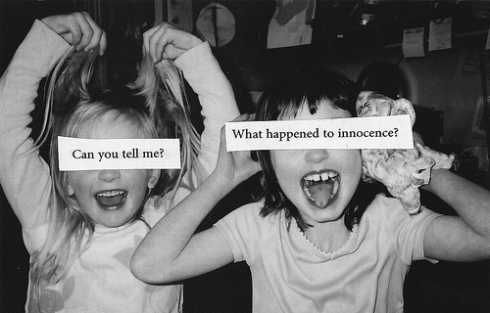
innocence

Breasts. Class. Public space. Language as a tool of repression

22 Jan

Discreet.  The word that has brought opprobrium down on the bald head of Channel 7 Sunrise host David Koch, after he used it to describe his preferred demeanour for women breast-feeding their babies in public spaces.

Koch, affectionately known as “Kochie,” was commenting on the decision of staff at the Bribie Island Aquatic Centre to request that a nursing mother remove herself from the public gaze, as she sat at the edge of the pool watching her two older children whilst feeding her baby. The comments can be seen here. Briefly, Koch agrees there is nothing wrong with breastfeeding in public as long as it is done “discreetly” and in a “classy” manner. Koch reiterated his views yesterday. He has another piece  today in The Punch in which he again confirms his views, titled “I’m not anti breast-feeding just pro politeness.”

He also tweeted: david koch ‏@kochie_online

But I don’t think it’s unreasonable to expect breast-feeding in public is done discreetly. I think that’s just a common courtesy to others

That most middle class admonition, to be discreet, means: having or showing discernment or good judgment in conduct and especially in speech; prudent, especially capable of preserving prudent silence; unpretentious, modest, unobtrusive, and unnoticeable.

That most aspirational instruction, to be classy, means: having or showing class; elegant, stylish; having or reflecting high standards of personal behavior; admirably skilful and graceful.

Then there’s that other most middle class admonition: be polite

And that much-loved phrase: common courtesy

Dog whistling, the lot of it, with less than zero relevance to breast-feeding in public.

Women should, according to Koch, acquire all these characteristics prior to feeding their infants in a public place. As he feels the need to incessantly repeat himself on this over a period now of some three days, he obviously considers that many women are seriously lacking in these highly valued middle class virtues, and in their ignorance, are offending and distressing the sensibilities of the bourgeoisie, who everyone knows are absolutely entitled to live in a world where nobody does anything that might offend them. Their world, their rules?

Neither Koch nor anybody else who has endorsed his views has explained exactly what it is about women feeding babies that is indiscreet, lacking in class, impolite, or offensive to another’s sensibilities. Neither have they explained how it is “discourteous” of a woman to expose the amount of breast needed to feed a child. This is not actually a great deal. An everyday lingerie advertisement will reveal far more.

Then there is the article at The Punch by Anthony Sharwood, who offers this:

But I can tell you from experience that there are some women who breastfeed anywhere they can as a sort of public exhibition of motherhood

So much of parenthood these days has become an act of display, from superprams as sophisticated as F1 cars to those who go down the overtly organic, super-healthy track.

Public breastfeeding has become, for some Mums, the last frontier of showy parenthood. What started as a private, intimate thing has become its exact opposite. I breastfeed therefore I am liberated. Yeah righto, we get it.

I take it that Mr Sharwood also would prefer us to be prudently silent, unpretentious, modest, unobtrusive, and unnoticeable. He also objects to breasts flopping all over his dinner table because feeding breasts are not sexy.

The reason why Koch’s observations matter is explained in an excellent piece in The Conversation:

Embarrassment and concerns about breastfeeding in public are primary reasons women stop breastfeeding early. And comments like Kochie’s that endorse restricting a breastfeeding woman’s access to certain areas of public space further remove breastfeeding from public display. This increases breastfeeding mothers’ social discomfort and makes it difficult for them to do what we otherwise expect them to.


The article also explains why denying women the right to breast feed in public is illegal, no matter what the manner in which they choose to do it.

An excellent piece on the human rights aspect of the action taken by the Bribie Island Aquatic Centre & Koch’s subsequent endorsement was posted by Kate Galloway here

There’s been something of a furore about the issue on Twitter. On my feed there have been objections to the concerns women have expressed about Koch and the Aquatic Centre. These have come overwhelmingly from men. Rather than analyse the mindset that would relegate women and babies to the toilets to feed, instead women’s anger about the situation has been targeted for discussion. Our anger has been described by some men as “rage,” “outrage,” “fighting,” and “faux rage,” and we’ve been described as “angry feminists.” We’ve been told to “get upset about something really important.” Someone tweeted that he was “exhausted” by our “outrage,” another that we were “ranting.” All pejorative descriptions of female anger because women don’t get angry like men, do we? We get out of control.

Some men need to learn that expressing emotion, even anger, does not equate to losing control.

Are you getting a feeling for the repressive use of language in this discussion? And don’t for a moment imagine Koch’s language is any less pejorative and repressive than that of the Twitter blokes.

Male tweeps have advised us that we’re not going about this in the right way, that our protest strategy will fail, that we have not thought through the two “nurse-ins” that were organized outside Channel 7 and Bribie Aquatic Centre.

Of all the belittling, scornful, repressive and dismissive comments tweeted on my feed to me and to other women today, only one I have seen has come from another woman.

I’m astonished that there are still men who think it their business to tell women what we ought to get upset about, and how we ought to express our concerns.

I’m astonished that there are still men who believe in an ideal of womanhood that requires us to refrain from expressing emotion in what they consider an unseemly fashion.

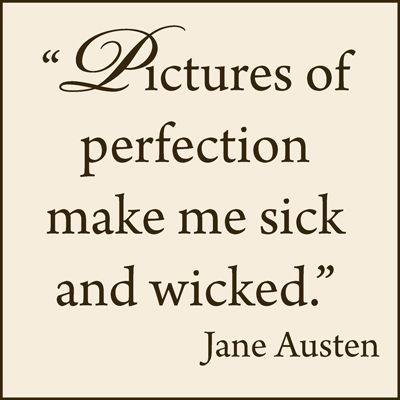
David Koch thinks we should be discreet, that is, and I will type this out again, so important do I consider it, we should have or show discernment or good judgment in conduct and especially in speech; be prudent, especially capable of preserving prudent silence; be unpretentious, modest, unobtrusive, and unnoticeable. He also thinks we should have or show class; be elegant, stylish; have or reflect high standards of personal behavior; be admirably skilful and graceful. What would Jane Austen, that most acute chronicler of manners, have to say?

Jane Austen quote

If this brouhaha has brought anything into stark relief, it is that the patriarchy is alive and well, and still dedicated to moulding women to its requirements. This is done not with force in this instance, but with language. It is done with efforts to control and shame us, expressed in language that is prescriptive, proscriptive, and judgmental. The tweeps, Koch and Sharwood share the same goal: to regulate female behaviour in public spaces using language that conveys disapproval and contempt, and is designed to shame.

If we must be discreet and courteous about breast-feeding, that implies there is something inherently offensive about it. As nobody has yet been able to articulate exactly what this offence is,  I can only conclude it is an emotional, irrational squeamishness that is triggered in some people when they see a baby at the breast.


Opponents of this most natural function will have to come up with a much better explanation than personal squeamishness if they are to have a leg to stand on in this matter. While many have defended Koch’s right to hold an opinion on this, I doubt his position can be described as an “opinion.” It is informed by nothing. It is an uncomfortable feeling he has. It is an emotional reaction. That is not opinion.

We are all responsible for our emotional reactions, we cannot demand that others protect us from them by ceasing to act in ways that provoke discomfort in us. In other words, if Koch or anyone else doesn’t like to witness a mother feeding her baby, perhaps they might like to put a blanket over their heads until she’s done. Or go sit in the toilets.

While many of the male tweeps involved thought Koch’s position was an idiocy, they failed to grasp that their reaction to our anger comes from the same place as that idiocy. Indeed, Koch’s idiocy was entirely lost in their emotional reactions to our anger, which became the focus for them.

Is all this an example of misogyny? I’m inclined to think not. It is the product of a misogynist patriarchy, so entrenched in some males they can’t even see what they’re doing, and get scared and angry when anyone calls them on it. I think it’s ignorance, rather than malice. I think it’s irrational fear.

Whatever it is, it most certainly isn’t opinion, which requires a good deal more than emotion. Koch’s unexamined emotions, and those of the male tweeps, shouldn’t be dignified with the title “opinion”, and they most certainly should not be respected as such.

The hospital and the radio station: when management fails who pays the price?

13 Dec


bad management message illustration design


Though there are many unknowns surrounding the death of nurse Jacintha Saldanha, what is starkly evident is that there are no winners in the aftermath of the prank. Images of her stricken family reveal just how badly things went wrong.

It appears that Saldanha played a very small role, merely answering the call from the two Australian DJs and putting it through to the appropriate staff member. It was not Saldanha who revealed royal medical details.

Having listened to the recordings, I understand why no one was more surprised than 2Day FM DJs Christian and Greig when their silly accents fooled staff, and they found themselves discussing the Duchess’s condition with her nurse. However, in the context, why should nursing staff be knowledgeable about silly Australian accents, and why should they be expected to be on the alert for pranksters?

Clearly hospital protocol regarding access to information about royalty and celebrity needs a review, not to protect those luminous beings, but to protect hospital staff who look after them. Surely it wouldn’t be difficult as a matter of course, to direct all inquiries to a PR professional and leave the medical staff to do their jobs untroubled by  pranksters.

It’s the nature of the prank that it takes its subject unawares, and plunges her or him into immediate confusion and self-doubt. The nurses involved may well have felt there was something amiss, and found themselves in the unenviable position of having to make a spilt-second decision that either way would backfire. What if they’d hung up on the Queen? What if they’d wrongly questioned her authenticity? The victim of a prank can never win.

I am interested to know how hospital management treated Saldanha. While a spokesman has been at pains to reassure her family and the media that she was not formally reprimanded, that doesn’t mean she wasn’t shamed in other ways within the hospital system, by administration and other staff. Was Saldanha held solely responsible because she answered the phone and put through the call? What about the nurse who gave out medical information?

DJs Greig and Christian have been widely blamed for instigating the prank that apparently led to Saldanha’s presumed suicide. However, it seems to me that like Saldanha, they are in some sense scapegoats for managerial hierarchies that have in both cases failed to adequately protect their coal face workers. Greig and Christian performed the prank, a prank that was approved by the station’s lawyers, and that was situated in a station culture of pranks. Apparently, the DJs can only air what is approved by management.

Saldanha, Christian and Greig have in common a position of being small but very visible cogs in powerful managerial wheels that are largely hidden and protected from public scrutiny.

No matter what one thinks of them, the careers of Greig and Christian may well be over. They are bearing the brunt of global fury at the dreadful outcome of the prank. At any time several layers of  2Day FM management could have pulled the plug. Nobody did. Will any management heads roll at the station?

Jacintha Saldanha is dead. Will any action be taken against the hospital management that failed to implement protocols to protect staff and patients from violation of privacy?

What is needed is an ongoing exposure of the normalised managerial culture that allows those with minor decision-making privileges to become scapegoats for the  less visible but extremely powerful individuals who are running the show. Ultimately these individuals are responsible when things go wrong, and they are responsible for the culture of the institutions they control.

Daily Life bitch slaps yummy mummies.

11 Dec

Up front, I’m not a fan of “most influential” anything lists, however I do like/admire several of the women on the latest such list doing the rounds at the moment, and I do think they have done more than their bit to challenge the stranglehold destructive orthodox attitudes still retain on our society.

But. When I read the blurb accompanying nominee Chrissie Swan, I felt like poking out somebody’s eyes. I don’t know who wrote it, but in one sentence they undermine the stated ethos of the entire “most influential” thing, and reveal what really occupies the minds of organisers of contests such as this one, which is the value or lack thereof, of a particular type of woman. 

Swan is described thus: “An earthy antidote to the proliferation of bourgeois, pearl-clutching yummy mummies, Swan’s influence lies in simply being herself.”

Where do I begin. I am so offended by this statement I can’t think quite straight, and I don’t even wear pearls. I did once own a very nice strand of quite good pearls with a garnet clasp, but I lost them because I am careless and do not understand the value of such things. I also like to think I was in my bourgeois youth a yummy mummy. I just dug out photos of me giving birth to my second child in a bean bag in our lounge room and my fingernails, as I thought, were manicured and painted bright red which in itself ought to be testament to my yumminess.

I was during this period entirely myself, despite my middle class circumstances, my yumminess and my pearls. Who else could I have possibly been? Can a woman only be herself if she owns no pearls, and works very hard not to be yummy? If the only real woman is the “earthy” non bourgeois variety that likely disqualifies most of the other nominees, none of whom look particularly “earthy” and all of whom look middle class, although Germaine Greer is if not earthy, at least a little bit scruffy.

Anyone with a skerrick of talent ought to be able to describe Chrissie Swan without resorting to pejorative remarks about women who are not Chrissie Swan in order to establish Ms Swan’s credentials. That the organisers of a most influential women contest have failed at this elementary task is discouraging for feminism and makes something of a mockery of the whole venture, despite their intentions to the contrary.


Pearl clutching.

Pearl clutching.


“Go Back” Series Two: human misery on prime time television with ads

2 Sep

I just watched two episodes of “Go Back to Where You Came From.” As with the first series, I again feel conflicted about the dire circumstances of refugees and asylum seekers being turned into spectacle for comfortable Westerners such as myself to gape at, and indulge in an emotional reaction of one kind or another from the safety of my couch.

It also offers an opportunity to camp on the high moral ground along with Allen Asher, Imogen Birley and Catherine Deveney.  Because even though I think Asher, Deveney and Birley’s positions are right and good and honest, and echo many of my own, we do get to occupy the morally superior position, a nice warm place to be, and that does give us the chance to look down on the likes of Peter Reith, Angry Anderson and Michael Smith who, initially at least, act like total crap.

I have to say I’m a bit bloody sick of this good and evil dichotomy. It’s all getting a bit George W Bush.

A justification for the co-opting of human misery to prime time television (complete with advertisements, I’ll get back to that) would be if three male participants whose minds were changed by their up close and personal encounters with fear, terror, hunger, thirst, illness and misery endured by millions every day were to become a voice for asylum seekers for longer than the interest in the television series lasts. Then much may be achieved, as they change the opinions of their bigoted followers and deprive the rabid xenophobes of a voice and leaders.

I’m mindful that since the first series of Go Back, things have got so much worse for boat arrivals. Clearly, whatever the personal epiphanies experienced by those participants, they’ve stayed personal, because our politicians have only got worse.

The first series hasn’t changed a thing for the better. And here we are again, gasping with outrage and emotion in between our dinner and the bedtime Milo.

Peter Reith, Angry Anderson and Michael Smith all have public platforms they could use to undo some of the damage they’ve already done to the public perception of asylum seekers who arrive here by boat. In particular, Reith was John Howard’s architect of the infamous Children Overboard affair. During that time,  asylum seekers were demonized as never before, and the mud the Howard government slung at them has stuck. It seems to me that the least Reith could do to compensate for what he now describes as a “stuff up,” is apologise for his part in that deadly “stuff up” and admit they were terribly, wickedly wrong about the children, women and men they exploited to stay in power.

The intrusion of advertising in Go Back revealed the show for what it really is: entertainment. Just when we got really involved with someone’s suffering and the whole damn disgraceful fucking situation, there’s an ad for a new car, food, furniture, whatever the hell they’re selling now, to remind us that it’s only television! It’s not our real life! Our real life is cars, food, furniture, whatever the hell else and this documentary is merely a distraction from what actually matters. An intense emotional experience brought to you by Toyota, and a bunch of people who’ll never ever own one.

I would love to believe that these series will bring about change. I would love to believe that enough minds will be changed as a consequence of viewing them. But I don’t. Which leads me to wonder what is this series really about? What is its purpose?

And what are its ethics?

Talking heads: STFU

29 Aug

While I agree that grief is certainly a state of consciousness that differs considerably from the everyday, I don’t think it’s quite another country as some would have it.

However, it does seem to have the capacity to throw everything outside its parameters into stark relief. Suddenly one sees that none of the emperors have clothes . For example, when I tuned into QandA on Monday evening I saw not a panel of distinguished and erudite guests, but a pack of braying, self-important, self-opinionated talking heads, about whom I could only think “Why? Why?” before silencing them with the remote.

Grief has severely curtailed my tolerance for talking heads. I have no idea why this particular group has become the target of my ill-will. I’m having the same difficulty with The Drum as I did with QandA.  Who are these people? I ask myself as I collapse, stunned and exhausted on the couch, looking for a bit of relief from the demands of living and dying. How did they come to be? Why are they everywhere? From what primary source have they metastasized? How is it that they manage to reduce the most intense, the most numinous, the most awful,the most terrifying, the most special of human experiences into highly articulate banality, just by opening their mouths about it?

Grief also disturbs one’s sleep patterns. The Dog and I sit alone in the lounge at 3 am, sharing Vegemite toast and drinking tea (well, The Dog doesn’t drink tea) and watching episodes of Breaking Bad. This comforts me. I need fiction like I need food and water.  I need story. I need a level of complexity and emotion that is absent in the clichés and sound bytes trotted out by the talking heads, who really, I’m beginning to believe, just want the chance to show everybody how clever they are. They’ll talk about anything. They aren’t required to have any expertise, or even to be particularly informed. All they need to know is how to talk.

I mean in what universe is it just fine for female genital mutilation to be reduced to a three-minute segment of  a talk show? Write about it, read about it, think about it, but chat about it?

In the midst of all my other troubles, there is the matter of my feckin’ Swedish chair. As some of you will know this chair has caused me injury in the recent past, to the degree that I put it out for the tip but was obliged by Mrs Chook to give it a second chance. Well, it has once again decided to throw its castors and land me on my arse on the floor. In the early hours of this morning I contemplated a trip to Ikea for a new chair. I imagined shopping in Ikea in my current state of consciousness. I see nothing to be gained by such an exercise, and much to be lost.

As I’ll be living in Sydney for a couple of months from next Monday, the chair won’t be an issue and maybe someone else will go to Ikea and get me a new one so I don’t have to.

The other thing is music. I can hardly bear to listen to music because so much of it makes me howl, and I mean howl. Not for me the quiet sob. I dare not use my iPod in public, for fear I will start to howl. As there is much of a practical nature to attend to , the time for the luxury of howling is not yet arrived, though I’m considering taking some alone time over the next day to close all the doors and windows, play music very loudly, and howl and thrash till I can howl and thrash no more.

Grief can be so alarmingly visceral.

On the whole, it seems to me from my admittedly jaundiced perspective, people talk too damn much. I could count on the fingers of one hand the people who have something interesting and substantial to say. Why can’t we have good story on our televisions instead of the crap opinions of professional talking heads? Who cares what most of them think? Who cares about their blah de blah de blah de blah? Who cares about their shallow pseudo analysis? Why don’t they all just STFU

PS: Sorry for the rant.

With media like this, who’d be an Olympian?

2 Aug

Sixteen-year-old Chinese swimmer Ye Shiwen put in an extraordinary performance. Her achievement was immediately questioned by US swim coach John Leonard, who raised the spectre of drug use.

With remarkable aplomb, Ye faced a clamouring pack of some 300 journalists, one of whom asked her directly, are you on drugs? Her father became involved. This was an example of the Western media’s arrogance and suspicion of Chinese people, he claimed. Chinese media took the accusations as an example of anti-China bias, and how the media spreads the unfriendliness of the West. “If Ye were an American the tone would be different in Western media,” the Chinese claimed.

Meanwhile, sports body FINA declared Ye Shiwen has been rigorously tested for drug use, has fulfilled all testing requirements for the last twelve moths, and is clean.

It isn’t only Chinese swimmers who attract the attention of a media set on making mischief for the women and men who make it to the Olympics. The fabricated scandal over Leisel Jones’ fitness is a fine example of how a pack behaves when it has nothing much better to do and craves our attention.

Then there was Emily Seebohm’s emotional reaction when she failed to win the gold medal in her swim race. It was gold for the media. So much more for them to mine than if she’d just won the damn medal.

Not only do Olympians have to be exceptional at their sport, they also have to negotiate a media that adores them when they achieve and trashes them if they come second, because apparently coming first is the only thing that counts.

A dysfunctional relationship has evolved between spectators, media and Olympians. Somewhere along the line, it has become the norm to expect gold and behave with punitive contempt towards the athlete when the expectation isn’t fulfilled. No wonder Seebohm felt she’d let everybody down. The reality is, she had let down a dysfunctional audience for whom winning means everything, while the achievement of representing the country in the first place, and winning any medal at all, counts for far less than nothing.

This is not Seebohm’s fault. She, like all the Olympians, is the figure upon whom the couch-bound audience and its slavering media project all the hopes and dreams they are incapable of fulfilling in their own lives. When their idols fail them, they turn feral and savage them. I’d challenge any one of those miserably carping, critical voices to test themselves in their own chosen field to the extremes these young Olympians must.

The attitude of many spectators and much of the media to Olympic athletes strikes me as infantile. “We want our country to be a country that wins lots of gold and if you don’t do that for us we’ll hate on you.”  This nationalistic attitude, in which the individual gains a sense of self-worth and identity through the achievements of his or her country’s elite athletes, is dysfunctional. We all have a responsibility to achieve our own personal best in our lives, not to project that onto others to do it for us.

I’m not very interested in sport, but I do have a huge admiration and respect for the athletes who make it to the Olympics. Somewhere along the way we’ve stopped acknowledging that as an achievement in itself and giving credit where credit is due. I don’t believe the Olympics is all about winning gold. It’s very sad that it has come to this, saddest of all for those women and men who have the determination and spirit to get themselves to that level of competition.